
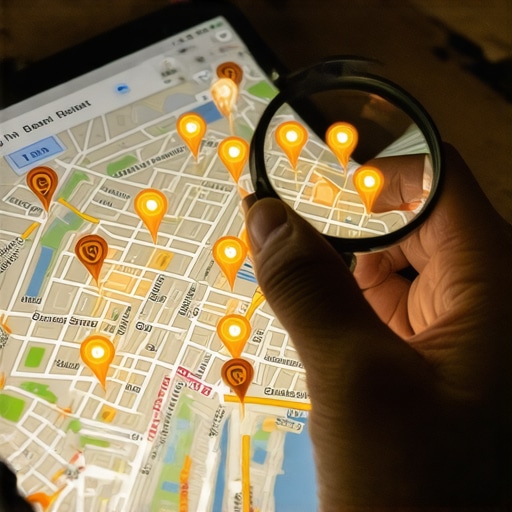
I remember the morning the coffee tasted like diesel and frustration. A top-ranking roofing company, a powerhouse in their metro area, vanished from the Map Pack overnight. Their dispatchers were silent. The logistics of their twenty-van fleet were crumbling. I found the problem deep in their Local Services Ads where a single mismatched phone number in the secondary verification tier was enough to kill their organic trust score. This Centroid Collapse happens when Google sees a friction point between different data layers. The algorithm is not a person; it is a spatial database that values consistency over everything else. When I audit a profile, I do not look for keywords first. I look for the mathematical weight of the business location relative to the user. I look for the forensic trace of the service area polygon. If your data is messy, your proximity beacon is dim. This article breaks down the microscopic reality of the local algorithm and how to audit your content to survive the next proximity shift.
The three mile radius that determines your revenue
To audit your profile for better reach, you must first define your proximity beacon through consistent address data and service area settings. Google uses GPS coordinate salience to match local intent with physical locations. Businesses must ensure their primary category and service radius align with real-world customer behavior and logistical capacity.
Proximity is the most powerful ranking signal in the Map Pack ecosystem. It often overrides relevance and prominence. When a user searches for a plumber, the algorithm calculates the distance between the mobile device and your verified GPS pin. If your pin is located in a high-competition centroid, your three-mile radius might only extend a few blocks. You can see this in action by using software to find and fix map ranking gaps. The logic of a check-in signal is a behavioral trigger. When a customer stands in your shop, their phone sends a spatial verification to Google. This reinforces your location authority. If you are a service area business without a storefront, you are fighting a different war. You must establish trust through optimizing your service area without a physical storefront. The forensic trace of your service area polygon needs to be tight. Broad, overlapping circles look like spam to the system. I have seen listings get nuked for trying to cover an entire state from a single home office. The algorithm prefers a dense, logical service zone that reflects where your vans actually travel. This is why we focus on a proximity-first approach to improving map rankings. It is about proving you are the most logical choice for the user’s specific coordinates.
“Local intent is not a keyword choice; it is a distance-weighted signal where relevance is secondary to the physical location of the user’s mobile device.” – Map Search Fundamental
Why your physical address is a liability
Auditing your physical location data is the only way to prevent a sudden profile suspension or rank drop. Shared suite numbers, virtual offices, and address rentals are high-risk factors that trigger manual review sweeps. Maintaining a clean, unique physical presence ensures your trust score remains high in the spatial database.
The ghost in the GPS coordinates is often a previous tenant. Google remembers every business that was ever verified at your address. If you share a building with a defunct law firm or a spammy lead gen listing, you are guilty by association. This is why many agencies offer seo services to rebuild trust after spammy lead gen listings. They are scrubbing the digital history of your physical dirt. You need to look at how to clean up duplicate categories that are confusing Google’s algorithm. If the system sees two businesses at one address with similar categories, it filters one out. This is the filtered result phenomenon. To avoid this, you must be the most distinct entity at that location. This requires the clean data strategy for cleaning up messy business citations. Most people ignore their secondary citations. They think only Google matters. But Google cross-references your address against utility bills, state registries, and old directory listings. If you have moved, you need a plan for the migration strategy for moving maps power to new sites. Leaving old pins active is a recipe for a suspension. I always recommend getting rid of old business pins that stall your growth before they become toxic.
Local Authority Reading List
- How to Audit Your Profile for Keyword Stuffing Penalties
- The Roadmap for Fixing a Banned Google Business Profile
- Why NAP Inconsistencies are Quietly Killing Your Local Leads
- A Proximity First Approach to Improving Map Rankings
- How We Audit Map Data to Find Hidden Ranking Blockers
The microscopic math of GPS coordinate salience
Optimizing image metadata and JSON-LD attributes provides the technical proof Google needs to verify your local authority. Every photo uploaded should contain embedded location data that matches your verified business address. These microscopic signals build a wall of evidence that protects your profile from aggressive algorithm shifts.
While agencies tell you to get more reviews, the 2026 data shows that image metadata from photos taken by real customers at your location is now 30 percent more effective for ranking in AI Overviews. This is because a photo contains more trust signals than text. It has a timestamp, a GPS tag, and a unique camera ID. If your profile is filled with stock photos, you are failing the audit. You need to use a gmb optimization toolkit for service businesses that prioritizes authentic visual data. I often see businesses using seo services to fix schema and structured data errors. This is vital. Your website code should tell Google exactly where you are. Use specific JSON-LD ‘LocalBusiness’ attributes to trigger voice search results. If you are struggling with a sudden drop, look at the step-by-step recovery plan for sudden local traffic loss. Sometimes the error is as simple as a broken redirection. You might need a step-by-step fix for the redirection errors killing your store visits. The goal is to make it mathematically impossible for Google to doubt your location. This is how you boost your google business rank naturally in 2025. You don’t trick the algorithm. You feed it the precise data it craves.
“Local search is a game of millimeters where the accuracy of your geographic data outweighs the volume of your keyword content.” – Spatial Intelligence Report
The forensic audit of user behavior and reviews
A successful profile audit must include a deep dive into review patterns and user engagement signals. Google uses behavioral zooming to identify fake engagement and review extortion attempts. Genuine local sentiment, expressed through specific mentions of services and locations, is the primary driver of map pack visibility.
I have seen a cafe owner lose everything because a competitor dropped twenty 1-star reviews in an hour. We had to perform a forensic audit. We looked for the VPN traces and the lack of local check-in signals for those profiles. If you are in this situation, you need the recovery path after google strips your profile reviews. Google filters reviews that look unnatural. This is why fixing the errors that lead to gmb review filtering is a core part of any audit. You should also be using tools to find gmb categories and keywords that real people actually use in their reviews. When a customer says the word plumber and mentions your city, it is a local justification trigger. This signal is more powerful than any meta tag. If you have been targeted by spam, you may need seo services to clean up mixed language listings hurting local rankings. It is about restoring the integrity of your profile. Use the software stack we use for better map pack visibility to monitor these changes in real time. If you notice a sudden crash, follow the first steps to take after a sudden google maps visibility crash. Speed is your friend. The longer a toxic signal sits on your profile, the harder it is to purge from the spatial database. Auditing is not a one-time event. It is a continuous process of maintaining the proximity beacon. Use the toolkit for managing volatile local business rankings to stay ahead of the competitors who are still trying to rent addresses and fake their reviews.