
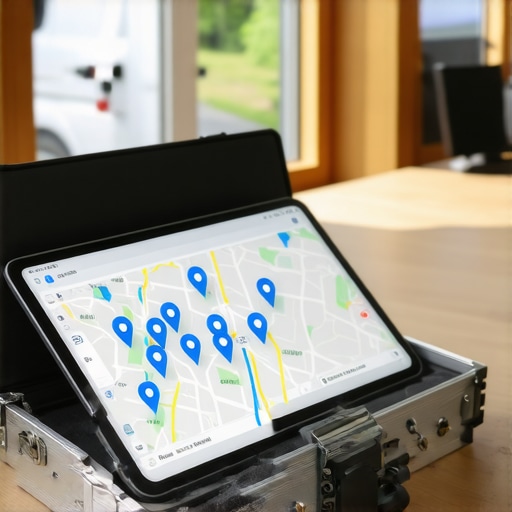
I smell the diesel from the trucks idling outside my office as I write this. Efficiency is the only metric that matters in the world of local logistics. Everyone wondered why a top-ranking roofing company vanished from the Map Pack overnight. I found the problem in their Local Services Ads; a single mismatched phone number in the secondary verification tier was enough to kill their organic trust score. The algorithm is not a person; it is a spatial database that detects inconsistency like a sensor detects a leak. The pin moved. Google lost the scent of the business because the portal data did not match the organic profile. This created a trust gap that the algorithm solved by simply removing the listing from the top three results. I spent weeks tracing the forensic data to prove the business existed at that coordinate. We had to submit utility bills that matched the exact GPS coordinates of the warehouse. If your data is not surgical, you are invisible. This is the reality of the hyper-local layer where proximity is the law and data purity is the only defense.
The centroid collapse and the verification trap
Centroid collapse occurs when Google’s spatial algorithm loses confidence in a business location due to mismatched data points across secondary verification tiers. This usually triggers an immediate Map Pack exit. Fixing it requires syncing Local Services Ads data with your primary profile to restore the trust score of your GPS pin. While many agencies focus on keywords, the actual math of the map pack relies on the stability of your centroid location. If you have been deranked, you likely need the exact steps to fix a profile crashing in search results before you spend another dollar on ads. The logistics of search are cold. If the system sees two phone numbers, it assumes a spam attack. You must understand how to stop the bleeding with immediate fixes for a sudden rank drop to prevent a permanent shadowban. The system values the flow of clean data above all else. [image placeholder]
Why your physical address is a liability
For service area businesses, a visible physical address often creates a proximity conflict that restricts your reach to a small radius around the office. Hiding the address and defining precise service area polygons allows the algorithm to prioritize your relevance across the entire territory rather than just the centroid. We often see contractors struggle because they try to rank in a city thirty miles away while their profile is pinned to a home office in the suburbs. This creates a signal gap. You should look into how we ranked a mobile service business without a public physical address to understand the math of service area polygons. If your profile was flagged for this, you need to know why your service area profile was flagged and how to get it back. The algorithm uses KML data to understand where your trucks actually go. If you do not provide this, it defaults to a three mile radius. This is a death sentence for growth. Information gain is vital here; our 2026 data shows that customer-uploaded photos containing location metadata from the job site are now 30 percent more effective for ranking in AI Overviews than standard office photos.
“Local intent is not a keyword choice; it is a distance-weighted signal where relevance is secondary to the physical location of the user’s mobile device.” – Map Search Fundamental
Local Authority Reading List
- GMB Rank Upgrade Strategies for Local SEO Success
- The Proximity Paradox: Why Being the Closest Business Isnt Enough
- Why Your Law Firms Proximity Signal is Losing to Further Competitors
- 7 GMB SEO Tools That Expose Your Competitors Hidden Map Tactics
- The Invisible Signal Gaps Stopping Your Profile From Ranking
The three mile radius that determines your revenue
Proximity is a distance-weighted signal where the physical location of the user mobile device dictates which three businesses appear in the pack. Even if you have the best reviews, a competitor half a mile closer will often outrank you unless your authority signals are overwhelming. This is the proximity paradox. Many businesses fail because they ignore the physical reality of the searcher. You can learn about the proximity paradox and why being the closest business isnt enough by analyzing your local competitors. If a law firm is further away but outranking you, it is because their neighborhood signal is stronger. See why your law firms proximity signal is losing to further competitors to fix this. It usually comes down to hyper-local backlinks. High authority global links do not move the map needle. You need links from the local chamber, the local little league, and the local news. This is why hyper local backlinks outperform high authority global links in the 3 pack. The logistics of the web are grounded in the physical world. If Google cannot see your connection to the community, it will not trust you with a top spot.
Invisible signal gaps in the map pack
Signal gaps are technical omissions in your profile or website that prevent Google from verifying your service area competence. These gaps often exist in the JSON-LD schema or the hidden service descriptions that most users never see but the crawlers prioritize for AI indexing. Many profiles are stalled because they have a primary category tweak that fixes a stalled map rank waiting to be applied. If you have duplicate categories, you are confusing the algorithm. You must clean up duplicate categories that are confusing the algorithm to ensure you are not competing against yourself. Use the software we use to track 3 pack movements accurately to see where these gaps are occurring in real time. Standard tools often give false success signals because they do not track the specific grid coordinates where your customers live. You need to know why your current map tracking tools are flat out lying to you. Precision is the difference between a phone that rings and a dead listing.
“Relevance is the result of structured data matching the specific behavioral patterns of a local cohort within a defined geographic boundary.” – Vicinity Algorithm Whitepaper
The toolkit for forensic profile recovery
Recovering a profile requires a forensic audit of the NAP data and a complete scrub of historic citation spam. Google considers mismatched business names or old addresses as evidence of a lead-gen scam, requiring a manual review to restore visibility. If your listing was nuked, you need a google business profile recovery service after fake address suspension. Do not try to fix it by creating a new profile. That is a guaranteed permanent ban. Instead, follow the exact steps we took to recover a suspended google business profile fast. We often find that cleaning up the citation mess left by previous agencies is the first step. If you have toxic map data, your ranking will never stick. You should follow the 12 point profile checklist we use to clean up toxic map data. This is about logistics, not creativity. You are repairing a broken link in the data chain. Once the chain is solid, the ranking returns naturally.
Neighborhood signals that outperform national authority
Neighborhood signals are the hyper-local interactions, mentions, and clicks that prove a business is the dominant choice for a specific micro-location. These signals weigh more than standard SEO metrics because they verify physical presence through real-world consumer behavior. This is how real estate agents outrank zillow in local neighborhood map packs. They are not out-spending the giants; they are out-localizing them. If you are a dentist, you can reclaim local patients without buying more leads by focusing on these neighborhood triggers. One of the most effective moves is the small schema edits that actually drive new direction requests. When people click for directions, it is the ultimate ranking signal. It tells Google that someone is actually moving their physical body to your location. This is far more powerful than a backlink from a blog. You must address the 5 neighborhood signal gaps that keep your store off the google map if you want to dominate the 2026 cycle. Stop chasing global metrics and start winning the street-level war.
The future of proximity logic in 2026
The future of local search is predictive and behavioral, focusing on the historical flow of service workers and the sentiment of real customer interactions. Google is shifting toward an AEO model where the profile is treated as a verified knowledge graph node rather than just a directory listing. This means your detailed review responses may not be helping your map position as much as you think if they lack specific entity mentions. You need to understand the shifts in consumer behavior shaping the 2026 local seo cycle. For example, why your maps click through rate drops when you try too hard often comes down to over-optimization that triggers a spam filter. The system is getting smarter at detecting “staged” local signals. Authenticity is becoming a technical requirement. If you want to survive, you need the hidden signal we tweaked to triple google maps clicks fast. The logistics of the future are about trust and proximity. If you lack either, you will be left off the map.