
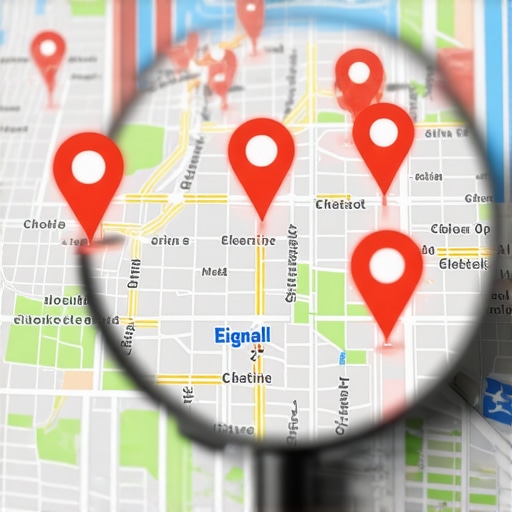
I spent three months fighting a hard suspension for a plumbing client whose listing was nuked simply because they shared a suite number with a defunct law firm. Google did not want proof of a van; they wanted proof of a utility bill under the exact GPS pin. This was my introduction to the brutal reality of the local algorithm. If the spatial database sees a conflict in the physical layer, your business ceases to exist in the digital layer. I have investigated map spam for two decades and I can tell you that the difference between a ranking leader and a ghost listing is often a few meters of coordinate drift or a mismatched suite number. You cannot treat a Google Business Profile as a social media account. It is a proximity beacon that must satisfy rigid mathematical requirements for trust and physical presence.
The ghost in the GPS coordinates
Google Business Profile ranking relies on proximity signals and GPS coordinate salience to determine the Map Pack results. The algorithm identifies spatial database discrepancies where a physical business address fails to match the NAP consistency of local citations. Understanding how local intent triggers specific neighborhood centroids is the first step toward ranking success.
When we look at the microscopic math of a local search, we are looking at the way a mobile device communicates with nearby Wi-Fi MAC addresses and cell towers to establish a high-confidence location. If your business claims to be at a specific coordinate but customer phones never ping from that coordinate, you create a signal gap. This is why address rentals and virtual offices are getting decimated in the latest updates. The algorithm is looking for the heartbeat of physical traffic. It monitors the dwell time of users within your geofenced perimeter. If you are using a [gmb ranking toolkit for small business owners](https://gmbrankupgrades.com/why-beginners-often-struggle-with-map-visibility-and-how-a-toolkit-fixes-it), you must ensure it tracks these behavioral pings accurately. I have seen listings disappear because the owner was logging in from a VPN in another state, which conflicted with the business location. This triggered a manual review that the owner could not win. You must align your digital access with your physical reality. This is not about keywords; it is about the forensic trace of your business operations.
“Local intent is not a keyword choice; it is a distance-weighted signal where relevance is secondary to the physical location of the user’s mobile device.” – Map Search Fundamental
Why your physical address is a liability
Google Business Profile suspensions occur when the algorithm detects address rentals, virtual offices, or shared suite numbers. High-risk categories like plumbing or locksmithing undergo rigorous manual reviews to confirm verified storefronts. Using utility bill proof and clear physical signage is the only way to satisfy the geographic relevance requirements.
The issue often lies in the historical data of a building. If a previous tenant was banned for lead gen spam, that suite number is now toxic. When you move in and try to verify your legitimate business, you are walking into a trap. The algorithm remembers the ghost of the previous spammer. This is where [seo services to remove google manual action](https://gmbrankupgrades.com/a-practical-guide-to-reinstating-banned-local-listings) become necessary. We have to scrub the digital history of that physical space and prove to the spam team that the ownership has changed. This involves more than just a video verification. We often need to show the lease agreement, the business license, and the actual tools of the trade. I once had to film a plumber’s entire inventory in the back of his truck just to prove he was real. Google is tired of being lied to. If you are struggling, check [the roadmap for fixing a banned google business profile](https://gmbrankupgrades.com/the-roadmap-for-fixing-a-banned-google-business-profile) to see if your address is the primary blocker. Sometimes the only fix is moving to a new office that hasn’t been flagged by spammers. It is a high price to pay, but the Map Pack is the lifeblood of local commerce.
Local Authority Reading List
- A Proximity First Approach to Improving Map Rankings
- The Fix for Stubbornly Banned Local Business Listings
- The Roadmap for Fixing a Banned Google Business Profile
- How to Handle a Google Maps Profile Suspension without Panic
- Getting Your Suspended Listing Back Online
[IMAGE_PLACEHOLDER]
The three mile radius that determines your revenue
Map Pack visibility is governed by a proximity radius where local intent overrides standard SEO signals. A business must build geographic density through local check-ins, customer photos, and localized content to rank within a neighborhood centroid. Using local seo software to improve map pack rankings helps identify where your proximity signal drops off.
Think of your business as a radio station. The closer the user is to your tower, the clearer the signal. As they drive away, the signal fades until a competitor’s tower takes over. In 2025, that radius has shrunk significantly. The Vicinity update made sure of that. Now, if you are more than three miles away from the searcher, your chances of appearing in the top three are slim unless you have massive authority. To combat this, you need to use [the specific toolkit moves that rank small service area businesses fast](https://gmbrankupgrades.com/the-specific-toolkit-moves-that-rank-small-service-area-businesses-fast). This involves building neighborhood-specific pages that are not just keyword-stuffed shells. They need to include local landmarks, specific street intersections, and reviews from people in those exact zip codes. This builds a web of local relevance that extends your radius. I have seen businesses double their leads just by cleaning up their [reputation management and review repair services](https://gmbrankupgrades.com/winning-back-your-map-position-after-a-review-purge) to focus on local sentiment. Google looks at the language used in reviews. If a customer mentions the name of the town or a local park, that review carries triple the weight for local ranking. It is a behavioral signal that confirms you are actually doing work in that area.
“Relevance in local search is a byproduct of geographical proximity and historical user interaction data points.” – Location Intelligence Whitepaper
The digital residue of a suspended listing
SEO services to rebuild trust after spammy lead gen listings are essential for businesses that have been caught in a manual review sweep. The process involves fixing over optimized anchor text and cleaning up ai generated spam content. Recovering local search traffic requires a clean backlink profile and the removal of toxic local spam signals.
When a listing is banned, it leaves behind a residue of broken links and mismatched data. If you try to start a new listing without cleaning up the old one, you will get suspended again within 48 hours. The algorithm recognizes the fingerprint of your business name, phone number, and website. This is why [seo services to clean up ai generated spam content penalties](https://gmbrankupgrades.com/debugging-a-map-rank-drop-finding-the-toxic-content-culprits) are so vital. You have to go back and audit every single citation. You must find the [scrubbing duplicate citations to fix your local search presence](https://gmbrankupgrades.com/scrubbing-duplicate-citations-to-fix-your-local-search-presence) methods that work. If there are five different versions of your name on the web, Google loses trust. It doesn’t know which one is the real you. This is especially true after a [why the recent core update crushed your local traffic](https://gmbrankupgrades.com/why-the-recent-core-update-crushed-your-local-traffic) event. The algorithm becomes more sensitive to inconsistencies. I once spent a week just calling old directories to delete listings for a client who had moved three times. It was tedious, but it was the only way to get them back into the 3-pack. You cannot build a new house on a poisoned foundation. Clean the data first, then focus on the ranking.
The forensic math of customer review sentiment
Reputation management and review repair services focus on the mathematical weight of local review sentiment. Google analyzes the forensic trace of user profiles to detect fake reviews and VPN usage. Authentic customer photos with location metadata are now more influential for AI Overviews than text-only reviews.
I once worked on a review extortion case where a competitor dropped twenty 1-star reviews at midnight. We had to prove to Google that these accounts had no physical history in the city. Real users have a trail of GPS data; they visit grocery stores, parks, and other businesses. Fake accounts created in bulk are ‘sterile.’ They have no location history. This is how Google’s spam filter works. If you are hit by a review purge, you need [a street level plan to recover deleted google reviews](https://gmbrankupgrades.com/a-street-level-plan-to-recover-deleted-google-reviews). You have to show that your reviews came from real humans. I always tell my clients to encourage customers to take photos of the work while they are at the house. A photo with embedded GPS coordinates is an ironclad proof of service. It is a signal that no spammer can fake. This is the level of detail required for [the reputation blueprint building trust across multiple business locations](https://gmbrankupgrades.com/the-reputation-blueprint-building-trust-across-multiple-business-locations). Every location must prove its own worth through the eyes of the local residents. If you try to shortcut this with a [gmb vs local listing tools comparison](https://gmbrankupgrades.com/comparing-local-seo-suites-which-features-actually-move-the-map-pin), make sure you choose the tool that monitors review integrity above all else.
The service area polygon and duplicate conflicts
Service area businesses often face duplicate listing issues because of overlapping service polygons. Google’s algorithm flags multiple business names at one address as a violation of TOS. Solving these technical errors requires merging hidden duplicate profiles and defining clear service boundaries to avoid ranking drops.
Many business owners think they can rank in ten different cities by creating ten different listings. This is a fast track to a hard suspension. Google expects one listing per business entity unless you have a physical office in each location with its own staff. If you are a service area business, you should use the service area setting and define your polygon accurately. Do not try to claim a 100-mile radius if you only have one truck. The algorithm knows the average travel time for your industry. If your polygon is unrealistic, you look like a lead gen spammer. This is why [why your service area overlap is causing duplicate listing issues](https://gmbrankupgrades.com/why-your-service-area-overlap-is-causing-duplicate-listing-issues) is a common topic in my consultations. You have to be strategic. Use [the toolkit service businesses need for better map rankings](https://gmbrankupgrades.com/the-toolkit-service-businesses-need-for-better-map-rankings) to see where your competitors are vulnerable. Instead of creating fake locations, dominate your primary area and then expand through local authority. If you find yourself with [merging hidden duplicate profiles killing your visibility](https://gmbrankupgrades.com/merging-hidden-duplicate-profiles-killing-your-visibility), fix it immediately. One strong profile will always out-earn ten weak ones that are constantly being suspended. The algorithm rewards stability and longevity.
The technical debt of slow local page loads
Technical SEO fixes like fixing slow page loads and broken redirects are vital for maintaining Google Maps lead flow. A slow website negatively impacts local map rankings because the algorithm prioritizes user experience. Ensuring website code is optimized for mobile users is a fundamental ranking signal in 2025.
Your website is the ‘backing’ for your Google Business Profile. If your site takes five seconds to load on a mobile phone, Google will not trust you with a high-intent local searcher. They want to provide the best experience possible. This means your [seo services to fix broken redirects and 404 errors](https://gmbrankupgrades.com/a-step-by-step-fix-for-the-redirection-errors-killing-your-store-visits) must be on point. I have seen businesses lose their 3-pack spot because they moved to a new domain and didn’t properly [migrate rankings from old domain without losing gmb power](https://gmbrankupgrades.com/the-migration-strategy-for-moving-maps-power-to-new-sites). The loss of link equity and the presence of technical errors signals to Google that the business is in flux. It is no longer a ‘safe’ recommendation. You need to focus on [the real impact of slow site speeds on your local map rank](https://gmbrankupgrades.com/the-real-impact-of-slow-site-speeds-on-your-local-map-rank). Use lightweight code and optimize your images. Every millisecond counts when a customer is looking for a ‘plumber near me’ on a spotty 5G connection. If your site fails to load, they click the next business in the list. Google tracks this behavior. If your click-through rate is high but your ‘back’ button rate is also high, you will fall. The digital and physical layers are inseparable. You must master both to stay on top of the Map Pack. Stop chasing ghosts and start building a foundation of real data and technical excellence.